

Book your demo
Ditch the sales tax complexity.
Ditch the sales tax complexity.
Talk to a TaxJar expert today and automate your compliance from calculation to filing.
Book your demoHow to navigate sales tax for online vs brick-and-mortar stores
For the modern entrepreneur, the line between selling on a digital screen and selling behind a physical counter is disappearing as e-commerce has taken center stage. But for state tax departments, these two worlds are governed by entirely different playbooks.
If you aren’t comparing the rules for physical nexus versus economic nexus, you’re likely leaving money on the table—or worse, inviting an audit. By leveraging automation tools like TaxJar, you can bridge this gap and focus on growth instead of paperwork.
The deep dive: decoding the differences
A common mistake retailers make is assuming all sales tax compliance is created equal, regardless of your sales channels. In reality, a brick-and-mortar shop is an easier sales tax setup, while an online store is a forever-evolving puzzle. Here is a breakdown of the four critical factors that separate physical retail from digital commerce.
1. Obligation trigger: Physical vs economic nexus
At the heart of sales tax is the concept of nexus: the legal connection between a business and a state that creates an obligation for a business to collect sales tax in that state.
- Physical nexus (the brick-and-mortar standard): This is triggered by a physical presence. If you have a building, a warehouse, or employees in a state, you likely have physical nexus and must collect sales tax on items sold in that state.
- Economic nexus (the e-commerce standard): Following the 2018 South Dakota v. Wayfair ruling, states can tax remote sellers (sellers located outside of the state where they do business) based on sales or transaction volume. If you sell a certain dollar amount or hit a transaction count in a state, you have economic nexus there, even if you’ve never set foot in that state.
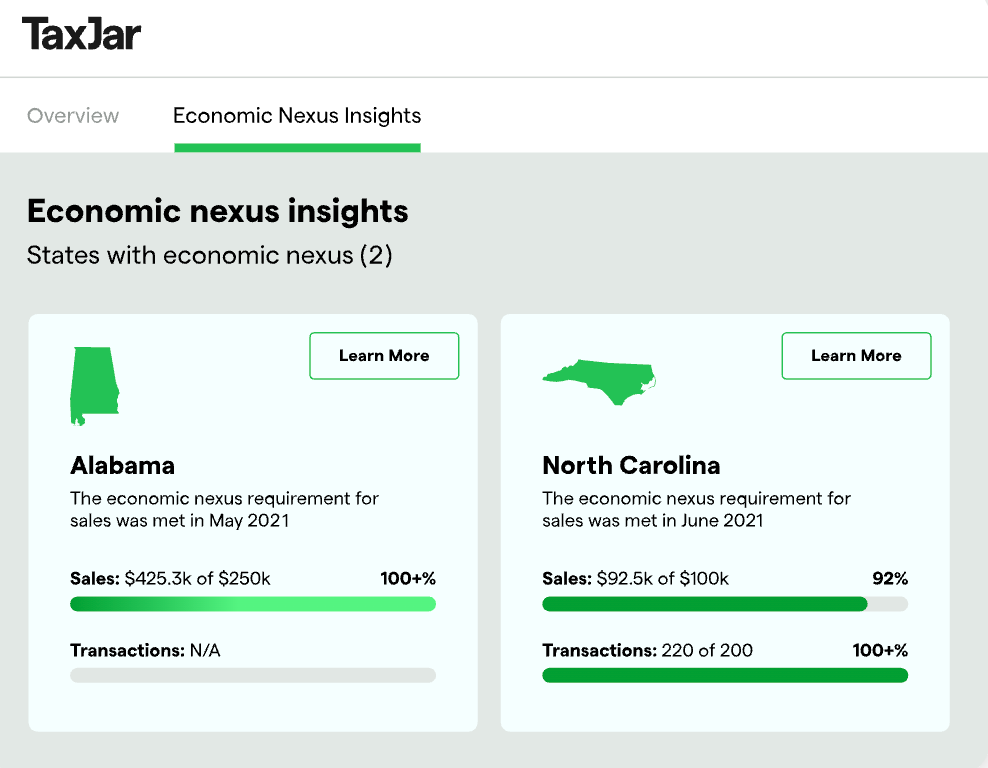
Physical nexus is more straightforward, usually tied to your storefront or warehouse. Economic nexus is a moving target and can change based on where your customers are located. When you sell online, you can trigger a tax obligation in a state you’ve never even visited. TaxJar makes this easier for online sellers, by automatically monitoring sales across all channels. Our dashboard alerts you when you are approaching a state’s threshold ensuring you know exactly when and where you need to register.
2. Tax rate logic: Origin-based vs destination-based
States generally require sellers to collect sales tax in one of two ways (this is referred to as sales tax sourcing):
- Origin-based collection:
- Destination-based collection
Origin-based sales tax source
Sellers that are based in states with origin-based sales tax sourcing are required to collect sales tax at the seller’s business location. If your business is in an origin-based state, you should charge all customers in that state the combined rate for where your business is located. The combined rate is the state sales tax rate plus any county, city, or district tax rates. For example, if your business’s location is in Arizona, you charge all customers in Arizona the same combined sales tax rate. This is considered the simplest form of sales tax sourcing, because businesses only need to charge one sales tax rate to all customers in the state.
Destination-based sales tax sourcing
Destination-based sales tax sourcing is more complicated. Destination-based sales tax sourcing means sellers are required to charge the combined sales tax rate at the customer’s address. Since states can have hundreds of different tax jurisdictions, the rates can vary widely across customers in the state. For example, if your business is located in Washington, you charge all customers the state sales tax rate of 6.50% plus any local sales tax in effect at the customer’s location.
You can see the breakdown of which states are destination-based and which are origin-based in this blog post.
In a brick-and-mortar store, you use origin-based logic. The sale happens at your counter, so you charge the tax rate of your store’s address. For digital commerce, tax logic shifts from point of sale to the point of delivery. Since the sale happens where the customer receives the item, every single order could have a different tax rate depending on the customer’s doorstep. TaxJar’s API and tax engines ensure rooftop-accurate, real-time sales tax calculations based on location. Instead of guessing based on broad zip codes, it uses exact GPS coordinates to calculate the state, county, and local taxes at checkout, so you always collect the right amount.
3. Rate complexity: One tax rate vs 11,000 tax jurisdictions
A physical store owner has minimal sales tax rate complexity. You only need to be aware of the specific tax laws of the city and county where your store sits. An online seller faces more complex rate calculations, since there are over 11,000 different tax jurisdictions in the US, each with its own specific rates and rules. Without automation, e-commerce businesses must manage the complexity of over 11,000 tax jurisdictions simultaneously.
TaxJar keeps its tax engine updated in real-time. Whether it’s a rate change in a specific county or a change in state law, changes are applied automatically so you don’t have to do any research or update rates. TaxJar has implemented over 1,000 tax rate and taxability changes in 2026 so far.
4. Registration requirements: One registration vs multi-state requirements
When you are operating a brick-and-mortar business in one state, you only have to have a sales tax permit in the state where your business is located. However, when you sell online, you might have sales tax obligations in multiple states, meaning you must register for a sales tax permit in more than one state.
Each state has their own registration process and it can be cumbersome and time consuming. TaxJar can register for sales tax permits on your behalf, saving you time and helping you avoid errors.
Online vs brick-and-mortar sales tax considerations
| Brick-and-mortar store | Online store (e-commerce) | |
| Sales tax obligation trigger | Physical nexus: Physical location or staff. | Economic nexus: Sales volume or transaction count. Physical nexus also applies if you have inventory stored in a state. |
| Tax rate logic | Origin-based: Based on the store’s address. | Destination-based: Based on the buyer’s address. |
| Rate complexity | Low: Usually one or two local rates. | High: Potentially 11,000+ local jurisdictions. |
| Registration requirements | Required only in the state where the business is located. | Required in every state where thresholds are met. |
Don’t let tax compliance stifle growth
The complexity of navigating diverse state tax laws shouldn’t be the wall that stops you from expanding into new markets or channels. While the prospect of managing tax obligations in additional states might seem daunting, bringing new filing deadlines, fluctuating rates, and unique local requirements, TaxJar is designed to turn that complexity into a non-issue.
We make scaling simple by centralizing your compliance in one place. Instead of manually tracking thresholds for every state, TaxJar’s Nexus Insights dashboard does the heavy lifting, monitoring your sales volume across all channels and alerting you exactly when you’ve crossed an economic nexus threshold. Once you’re registered, our rooftop-level accuracy engine ensures you are charging the correct amount for every specific local jurisdiction—whether you’re selling across the street or across the country.
By understanding the shift from physical to economic nexus and leveraging automation tools like TaxJar, you can shift your focus back to what matters most: growing your business.
To learn more about TaxJar and get started automating your sales tax compliance, start a free, 30-day trial today or book a demo with our sales team.
It's time to solve your tax complexity
Talk to a TaxJar expert about automating your sales tax compliance.