Book your demo
Ditch the sales tax complexity.
Ditch the sales tax complexity.
Talk to a TaxJar expert today and automate your compliance from calculation to filing.
Book your demoSales tax tasks your accounting team should do in January
January is one of the most critical months for sales tax compliance. As the dust settles from the holiday sales influx, your accounting team must pivot from revenue generation to a regulatory checkup. Between annual filings, changing product taxability rules, and sales tax holidays, the tasks completed this month set the tone for your entire fiscal year. We’ve compiled a list of the top sales tax compliance tasks your team should complete in early 2026.
1. Close out 2025 with annual and quarterly filings
January is unique because it is the convergence of monthly, quarterly, and annual filing deadlines. If you are filing in multiple states, filing can take a significant amount of time. Here’s how we recommend approaching it:
- Identify all deadlines: Ensure your team is tracking the 15th, 20th, and month-end deadlines across all 45 states with statewide sales tax.
- File zero returns: Remember that you are generally required to file a return in every state where you are registered, even if you had $0 in taxable sales for that period.
2. Perform a nexus check
End of year sales often push businesses over nexus thresholds so now is a good time to check where you have nexus, or where you might be approaching a threshold. There are two different types of sales tax nexus, or in other words, two different ways you can meet the requirements to collect and remit sales tax to a state: physical nexus and economic nexus.
Physical nexus is just that, a physical connection to a state. Examples of physical nexus (also sometimes referred to as “physical presence”) include employees, offices, stores, warehouses, conference attendance, servers, etc.
Economic nexus thresholds are based on revenue or sales amounts. For example, in Florida, sellers that hit $100,000 in revenue from buyers in the state in the previous calendar year have met the economic nexus threshold in the state. Other states, like Georgia, have both a transaction and revenue threshold: $100,000 a year in gross revenue, or 200 separate transactions in the previous or current calendar year. Once you’ve hit a threshold in a state, you must register for a sales tax permit before collecting sales tax.
Use January to audit your 2025 sales data to see where you’ve crossed the line.
- Review economic thresholds: Look for states where you exceeded limits—these are either transaction or revenue (or both) thresholds. A solution like TaxJar can manage this on your behalf, with our nexus insights tool.
- Factor in physical changes: Did your team hire remote employees in a new state or utilize new third-party warehouses in 2025? These physical connections can trigger nexus regardless of your sales volume.
- Register for sales tax permits: If you crossed a state threshold during the holidays, and your products are considered taxable in the state, your next priority is registering for a sales tax permit. TaxJar can register for sales tax permits on your behalf: visit our registration page to request our team of experts manage your sales tax registrations.
3. Reconcile returns vs. bank accounts vs. accruals
Your team should complete the final reconciliation loop and verify that the numbers align across your systems to avoid audit red flags.
- Verify remittances: Match the actual cash that left your bank account with the totals reported on your tax returns.
- Audit accruals: Ensure the tax you collected from customers matches the amount you remitted to the state. Discrepancies here often indicate “under-collection,” which can lead to paying back taxes out of pocket.
4. Update product taxability and renew certificates
State laws are not static; there were hundreds of sales tax rate changes and the creation of several new taxing jurisdictions in the US in 2025. In the first half of the year alone, states implemented more than 400 sales tax rate changes—nearly 25% more than during the same period in 2024.
Many legislative changes took effect recently, including Louisiana taxing shipping costs, Maryland taxing a number of IT services at a reduced rate of 3%, and Kansas and Illinois eliminating sales tax on grocery items.
- Update product taxability rules into checkout flows: If a product taxability change means you no longer need to charge sales tax on an item in a certain state, it’s up to you to ensure your checkout flow is updated to properly reflect the taxability change.
- Renew exemption certificates: Exemption and resale certificates often expire after 3-4 years. January is the time to reach out to customers that you have an exemption certificate for to request updated documentation for 2026.
5. Make note of 2026 sales tax holidays
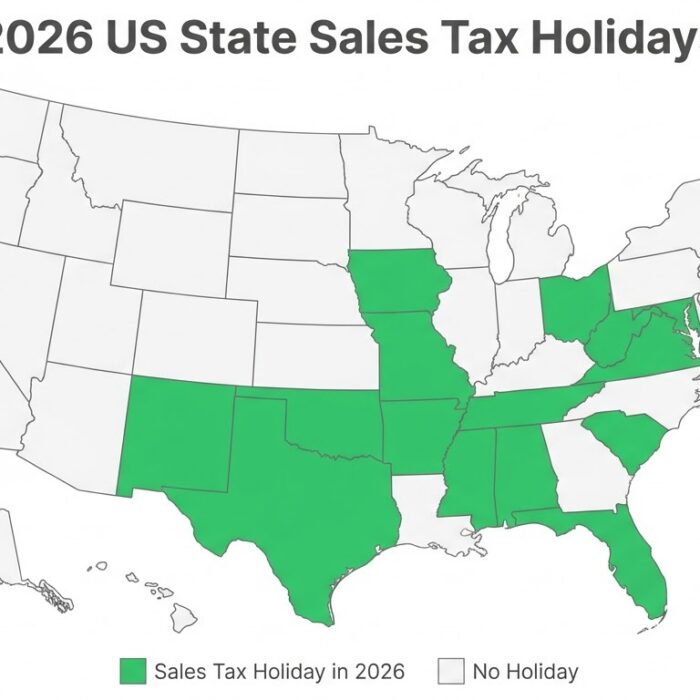
Don’t let tax-free weekends catch your team by surprise. Many states havesales tax holidays in 2026, giving consumers a chance to purchase back-to-school gear, emergency supplies, or energy-efficient appliances without paying sales tax.
- Plan for February: Alabama and Maryland have major sales tax holidays in mid-February for emergency gear and energy-efficient products.
- Automate the logic: Ensure your tax engine (like the TaxJar API) can honor these holidays so you aren’t over-charging customers during exempt windows.
How to simplify your tax compliance in 2026
Managing these tasks across 11,000+ jurisdictions is an immense burden for any accounting team. By combining your finances teams with TaxJar, you can streamline compliance in 2026. Our cloud-based platform automates the entire sales tax life cycle across all of your sales channels — from calculations and nexus tracking to reporting and filing. With innovative technology and award-winning support, we simplify sales tax compliance so you can grow with ease.
Get started for free with a 30-day TaxJar trial today, or reach out to our sales team if you have any questions.
It's time to solve your tax complexity
Talk to a TaxJar expert about automating your sales tax compliance.